Charity, Donation & Humanitarian Scams
Before anyone can steal your money, they will try to hack your mind. While most scams rely on fear or greed, charity scams are particularly insidious because they weaponize the best part of human nature: our empathy. By exploiting natural disasters, global crises, and our innate desire to help, bad actors bypass our logical defenses and turn our generosity into a vulnerability.
The Domino Effect of "The Earthquake Relief Fund"
David was scrolling through his social media feed on his lunch break. The news that morning had been dominated by reports of a devastating earthquake in a neighboring country.
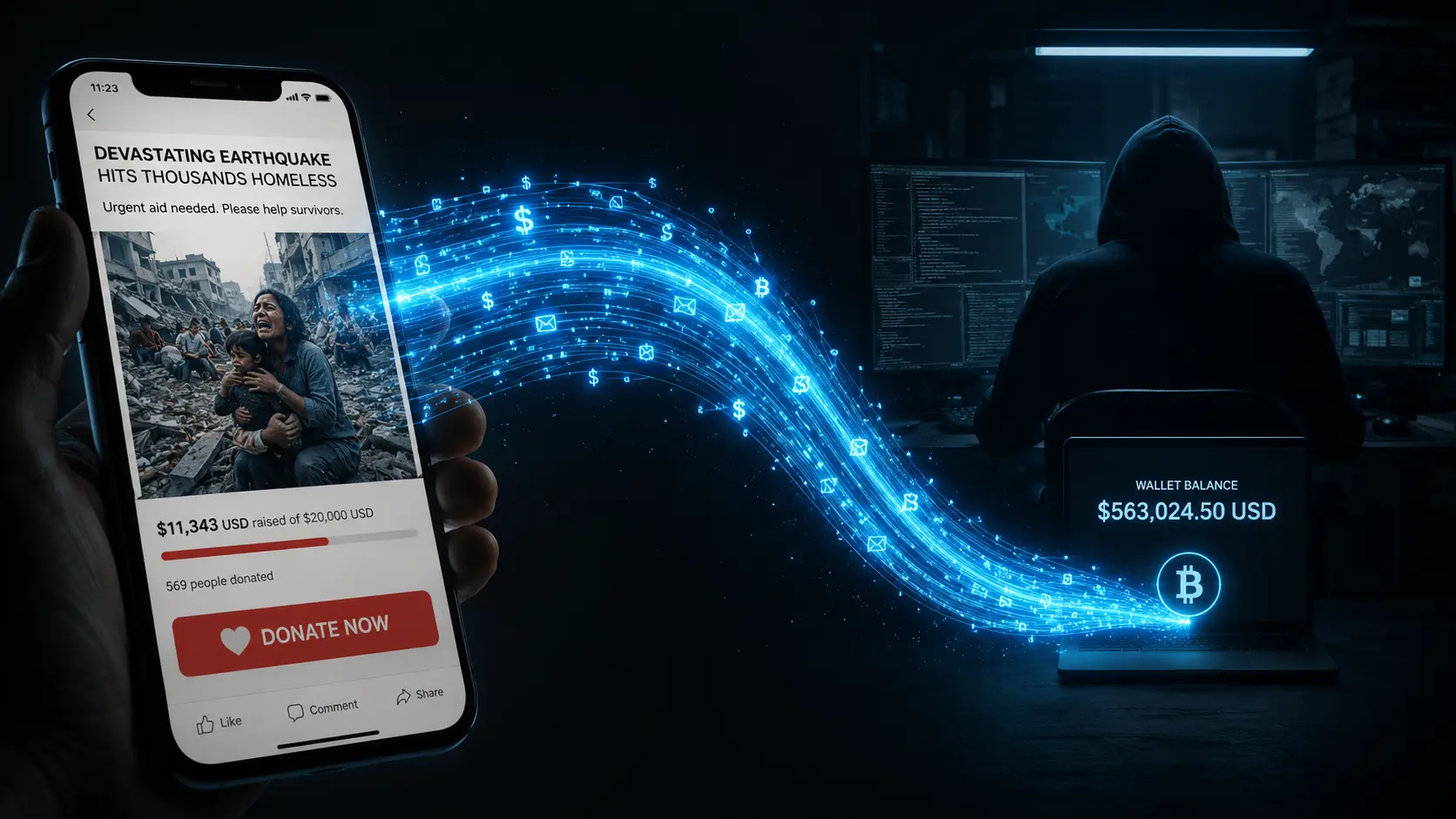
The Empathy Exploit: Scammers use breaking news to manufacture urgency, preventing you from verifying where your money is actually going.
Suddenly, a sponsored post appeared in his feed. It featured a heartbreaking, highly emotional photo of rescue workers pulling a child from the rubble. The text read: "URGENT: 24-Hour Emergency Rescue Fund. We need your help NOW to buy medical supplies. Every second counts."
The organization was called "Global Disaster Relief Network." It had a professional-looking logo and hundreds of comments saying "Praying!" and "Just donated!"
Driven by a sudden, intense surge of empathy and the tragic images on his screen, David didn't stop to verify the charity. The post created a sense of extreme urgency—if he waited, people might suffer. He clicked the link, which took him to a sleek, frictionless donation page. He quickly entered his credit card details and donated ₹5,000.
He even received a professional "Tax-Deductible Receipt" in his email.
Two weeks later, David noticed several unauthorized charges on his credit card. When he tried to look up the "Global Disaster Relief Network" to warn them of a data breach, the website had vanished. The comments on the post were generated by bots, the heartbreaking photo was AI-generated, and his donation had gone directly to an overseas fraud syndicate. His empathy had been successfully exploited.
The 6 Pillars of Charity Fraud
To understand how David was manipulated so quickly, we have to look at how modern attackers systematically construct fake humanitarian campaigns.
1. Fake Charities Exploiting Disasters
Scammers operate like newsrooms. Within minutes of a natural disaster, terrorist attack, or global crisis, they register lookalike domains (e.g., redcross-relief-fund.com) and launch fake crowdfunding pages. They rely on the chaos of breaking news, knowing people want to help immediately before the facts are clear.
2. Emotional Manipulation in Appeals
A legitimate charity will explain their logistics. A fake charity relies entirely on emotional shock. They use highly distressing images (often generated by AI or stolen from unrelated past tragedies) to trigger an "amygdala hijack," pushing your brain into an emotional state where logic and verification feel too slow.
3. The Urgency Illusion
"Every second counts." "Donate within 24 hours." Fake charities manufacture arbitrary deadlines. By convincing you that a delay will result in immediate harm to victims, they successfully stop you from taking the 60 seconds required to Google their organization's legitimacy.
4. Tax Deduction Fraud and Fake Receipts
Scammers know that modern victims look for professional signals. Fake charities will boldly claim to be registered 501(c)(3) or 80G tax-exempt organizations. They will send automated, professional-looking tax receipts immediately after you donate. The receipt is completely fake, adding insult to injury when the victim tries to claim it on their taxes.
5. Legitimate Charity Verification
Attackers count on you not verifying their claims. Real charities are legally required to be registered and transparent about their finances. If an organization cannot be found on independent verification platforms (like Charity Navigator, GiveWell, or local government registries), it is highly likely to be a scam.
6. Reporting Charity Fraud
Because charity fraud exploits goodwill, victims rarely report it—often because they never realize they were scammed, or they feel too embarrassed once they do. Reporting these fake portals to financial authorities immediately is the only way to get the domains taken down before they steal from others.
What Is Actually Happening: Exploitation
These core facts and statistics explore the psychological vectors targeted across humanitarian scams.
Shock Over Logic
When confronted with distressing images of victims, a person's emotional arousal spikes, which temporarily disables the critical thinking centers of the brain. Scammers use shocking imagery specifically to bypass your natural skepticism.
Breaking News Fraud
Over 70% of fake charity domains are registered within 48 hours of a major global news event. Fraud rings monitor the news and launch campaigns while public confusion is at its highest.
The Illusion of Trust
People are highly likely to donate if they believe others are doing the same. Scammers use bot networks to leave hundreds of fake comments, likes, and "just donated!" reviews on their ads to artificially manufacture social proof.
Now Try It From the Other Side
This is a working model of how psychological manipulation is sequenced in a charity scam.
You are looking at this from the attacker's perspective. Your goal is to get a target to bypass their natural skepticism and send you money. You must use Breaking News, Emotional Imagery, and Urgency to manipulate their empathy meter.
The simulation explores how an attacker systematically raises empathy while lowering skepticism, creating the perfect conditions to steal funds.
What That Just Showed You
The simulation highlights that charity scams are entirely dependent on emotional hijacking.
1. Urgency prevents verification.
If you have time to think, the scammer loses. By tying the donation directly to a life-or-death timeline (e.g., "Rescue funds needed in the next 12 hours"), the attacker forces you to skip your normal background check process.
2. AI imagery is the ultimate empathy hook.
Scammers no longer need to find real photos. They generate hyper-realistic, devastating images of victims (often children or animals) to instantly trigger your protective instincts and override your logic.
3. Frictionless platforms hide the destination.
Fake crowdfunding portals are designed to look exactly like legitimate ones. Because the payment process is so smooth and professional, the victim falsely assumes the backend organization must be vetted and secure.
Three Things Worth Doing
You don't need to stop being generous. You just need to change how you give. Pick one action to integrate into your routine.
1. Implement the "Pause and Verify" Rule:
Never donate via a link directly from an ad or a social media post, no matter how urgent it seems. Close the app, open your browser, and search for the organization on a verification site like Charity Navigator, GiveWell, or your government's charity registry.
2. Go Direct to the Source:
If a tragedy strikes and you want to help, go directly to the verified websites of established organizations (like the Red Cross, Doctors Without Borders, or verified UN agencies). Type the URL into your browser yourself.
3. Beware of Suspicious Payment Methods:
Legitimate charities accept standard credit cards through secure, verifiable processors. If a "charity" asks for donations via Wire Transfer, Cryptocurrency, Gift Cards, or direct Peer-to-Peer apps (like CashApp or direct UPI transfers to a personal name), it is a scam.
One Question Before You Continue
Why do scammers heavily rely on launching fake charity campaigns during the immediate aftermath of a natural disaster or breaking news event?