Commitment, Consistency & Sunk Cost
Attackers rarely begin with large requests. They start small, build gradually, and let your own psychology do most of the work.
The Exclusive Partner Program
Arun was a procurement manager at a growing technology company.
One afternoon, a LinkedIn message arrived from a professional consultant named Priya Sharma. She represented a technology startup looking for strategic partners.
The message was professional. The company website looked legitimate. The LinkedIn profiles appeared authentic. Nothing seemed suspicious.
Arun agreed to a short introductory call.
No money was requested. No sensitive information was asked for. Only a simple registration form. It seemed harmless.
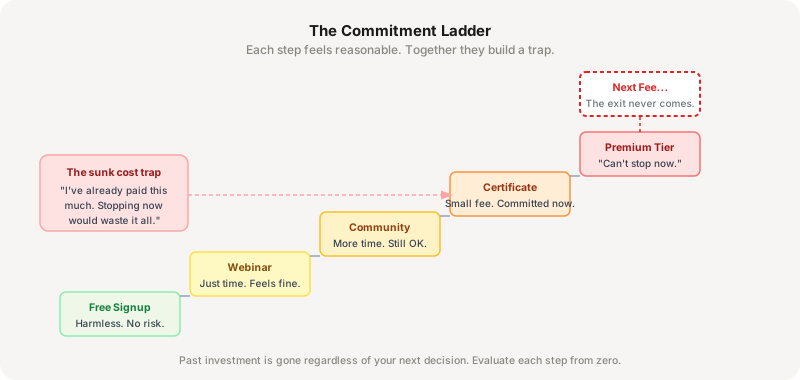
A week later, Arun was invited to an exclusive webinar. He attended. Then he joined a private partner community. Then he downloaded sales materials. Then he completed a certification course.
Each step required a little more time. Each step felt reasonable.
Months later, the company introduced a premium partner package. The fee was Rs. 5,000. Arun paid.
Soon there were additional fees - verification fees, compliance fees, marketing fees, partnership upgrade fees. Every payment felt justified because of everything he had already invested.
Then one morning the company disappeared. The website was gone. Customer support stopped responding. The community group was deleted.
The entire operation had been a scam. The attackers never hacked Arun's computer.
They hacked his commitment.
What Is Actually Happening: The Compliance Ladder
People naturally want their actions to stay consistent with previous decisions. Once we commit to something, changing direction becomes psychologically uncomfortable. Attackers exploit this tendency from the very first interaction.
3x
more likely to comply with a large request after agreeing to a small one first.
Each small yes makes the next larger yes significantly more probable. This is the foot-in-the-door effect - and it is the foundation of every escalating scam.
Source: Freedman & Fraser, Journal of Personality and Social Psychology, 1966; replicated across multiple modern studiesDoubling Down on Failure
People frequently continue investing in failing decisions because stopping feels like admitting the earlier choices were wrong. The more that has been invested, the stronger the resistance to stopping - even when warning signs are visible.
Past Investment Distorts Future Decisions
Money, time, and effort already spent cannot be recovered. Rationally, they should not influence future decisions. Psychologically, they almost always do. The attacker no longer needs to apply pressure - the victim's own investment history does it for them.
Acting in Line With Who You Are
Once a person commits to a position, they act in ways that reinforce that identity. Attackers frame requests as consistent with who the victim already is: "Someone with your expertise would recognise this opportunity."
Multiple Payments, One Trap
In reported investment fraud cases, over 70% of victims made more than one payment - with later payments typically larger than earlier ones. Commitment bias explains why warning signs did not stop the escalation.
The Foot-in-the-Door Technique
One of the most effective influence strategies starts with something almost anyone would say yes to.
Ask for something small. Gain compliance. Ask for something slightly larger. Repeat.
In Arun's case, the ladder looked like this: free registration, webinar attendance, community membership, certification course, small purchase, then escalating fees.
Each step appeared reasonable on its own. Together, they built a powerful commitment chain. No single step felt like the moment to stop. That is the design.
The Sunk Cost Trap
A sunk cost is any resource already spent that cannot be recovered - money, time, effort, reputation, or emotional attachment.
Rationally, past investments should not influence future decisions. Psychologically, they almost always do.
The internal logic sounds like:
"If I quit now, everything I have invested will be wasted."
Attackers rely on this thought. They do not need to force future compliance. The victim's prior investment does it for them.
The sunk cost trap becomes strongest at precisely the moment when warning signs are most visible - because that is when quitting feels most costly.
Warning Signs
Watch for these patterns:
- Requests gradually become larger over time
- New fees keep appearing after previous ones are paid
- You feel obligated to continue because of what you have already invested
- Leaving feels emotionally or financially uncomfortable
- Verification is discouraged or delayed
- Success is always described as "one step away"
These are not signs of a legitimate opportunity. They are signs of a commitment ladder.
Now Try It From the Other Side
You receive an invitation to an exclusive investment network.
Work through the five stages below. Watch how each decision changes your total exposure - and notice when the sunk cost pressure starts to build.
Try the path where you say yes to everything. Then try the path where you stop early.
What That Just Showed You
1. Attackers prefer gradual compliance over immediate demands.
A single large request creates resistance. A series of small requests, each slightly larger than the last, bypasses that resistance entirely. By the time the ask is significant, the pattern of saying yes is already established.
2. Time and money invested distort judgement.
Once a person has spent weeks engaging with a platform, attended events, completed training, and made initial payments, each new request is evaluated against all of that prior investment - not on its own merits. This is the distortion the attacker is counting on.
3. The sunk cost fallacy makes withdrawal feel like loss.
Stopping feels like confirming that everything invested was a mistake. Continuing feels like it could still pay off. Rationally, the money already gone is gone either way. The question is only whether more will follow it.
4. Evaluating each request from zero breaks the cycle.
Ask: "If I had never heard of this organisation before today, and someone sent me this request right now, would I agree?" This is the fresh eyes test. It strips the accumulated context and forces each decision to stand on its own.
Five Things Worth Doing
1. Name the ladder when you see it.
When requests have been getting gradually larger over time, name it out loud: "This is an escalating commitment pattern." Naming the technique is often enough to interrupt it.
2. Apply the fresh eyes test to any request that feels hard to refuse.
Ask: "If I had no history with this organisation, would I agree to this request today?" If the honest answer is no, the only thing making it feel acceptable is past investment - which is not a good reason.
3. Separate what you have invested from what you should do next.
Sunk costs are gone regardless of your next decision. The only question that matters is: given the current evidence, what is the right action from here? What you have already spent is not relevant to that question.
4. Verify independently before any new payment in an existing relationship.
If a person or company you are already involved with asks for a new fee, search the company name alongside "complaint," "scam," or "review" before paying. Contact the relevant regulator directly. Never use contact details supplied by the company itself.
5. Treat "one more step" as a red flag, not a promise.
Legitimate organisations do not require an escalating series of fees. If success is always one more payment away, that is not a promise. It is a structure designed to keep you paying.
One Question Before You Continue
Arun continued paying escalating fees despite warning signs. What was the primary psychological mechanism driving this?