Reciprocity, Duty & Obligation
Before anyone hacks your systems, they hack your instincts. The drive to return a favour and fulfil a duty is one of the deepest vulnerabilities in human nature. Attackers exploit your empathy, your professional obligations, and your natural guilt to get past your best defenses.
The Premium Report
Liam was a junior financial analyst, eager to prove himself.
One Tuesday morning, he received a LinkedIn message from "Marcus," a senior partner at a well-known consulting firm. Marcus praised a recent article Liam had shared and offered him an expensive industry forecasting report - completely free, completely unsolicited.
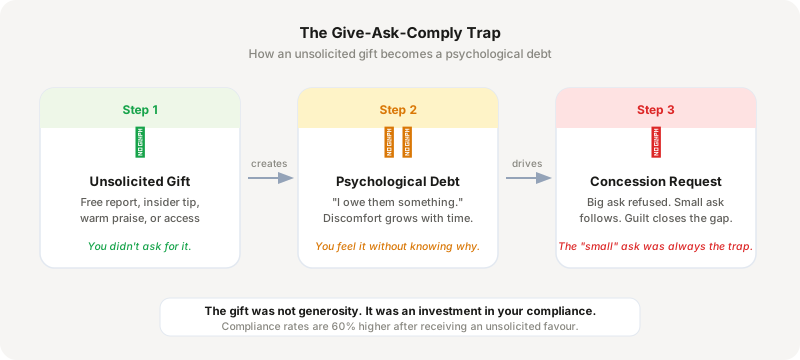
Liam thanked him. A subtle reciprocity debt had just been created.
Two days later, Marcus messaged again. He asked for a massive favour: could Liam share his company's internal Q3 projections?
Liam refused. He felt deeply uncomfortable saying no to someone who had just given him a costly gift - but he could not share confidential data.
Marcus was instantly understanding:
"No problem at all! Actually, could you just open this one-page PDF and tell me if the formatting looks okay on your end?"
Relieved that he did not have to disappoint Marcus a second time, Liam clicked the PDF. It silently executed a macro that installed a backdoor on his machine.
Liam had just fallen for a textbook concession tactic. The large request was never the goal. It was designed to be rejected, so that the smaller, real payload would feel like a compromise.
What Is Actually Happening: Your Helpfulness Is the Attack Surface
Social engineering does not target weakness. It targets the parts of you that work exactly as they should: generosity, empathy, and the drive to return a favour.
25%
of all data breaches in 2024 involved pretexting - building rapport or false context before the attack.
A free gift, a warm conversation, a shared LinkedIn connection. The setup is the attack.
Source: Verizon Data Breach Investigations Report (DBIR), 202460% Higher Compliance
Compliance with a subsequent request increases by over 60% after receiving an unsolicited favour - even when the request is highly suspicious or violates policy.
3x Higher on Follow-Up
A follow-up "small" request after an initial refusal has a 3x higher success rate than if that same small request had been made first. Rejection is part of the plan.
75% Acting on Duty
Over 75% of malicious payloads executed in corporate environments are triggered by employees who believed they were fulfilling a direct duty for a senior executive, HR, or IT.
Weeks of Setup
Modern spear-phishing attacks include an average of 3 weeks of rapport-building before the malicious request is made. The gift and the warmth are the preparation, not the preamble.
Unsolicited Favours and the Obligation They Create
When someone gives us something - even if we didn't ask for it - we feel a subconscious pressure to return the favour. Psychologists call this reciprocity. Attackers call it leverage.
Free software, premium reports, insider tips, and warm professional praise are not generous. They are investments in your compliance. The attacker spends weeks building a psychological bank account they will later withdraw from. The more valuable the gift feels, the harder it is to say no when the ask comes.
True generosity has no strings attached. In the digital realm, unexpected gifts from strangers almost always do.
Concession Tactics and the Empathy Gap
Also known as the "door-in-the-face" technique: ask for something unreasonable first. When refused, immediately offer something much smaller.
Because they "compromised," you feel pressure to compromise in return. The large request was designed to be rejected. It exists only to make the small request feel reasonable by comparison.
Attackers also weaponise empathy directly. They impersonate confused new hires, stressed vendors, or elderly customers. Your instinct to help is genuine. Attackers know this and engineer distress specifically to trigger it. When a surge of empathy arrives with an unusual request, pause before acting.
Duty, Workplace Roles, and Recognising the Setup
HR staff open attachments. Customer support responds to external queries. IT resolves tickets from unknown users. These are job requirements - and attackers know every one of them.
Impersonating executives, legal entities, or IT departments specifically targets role-based duty. The employee is not making a personal choice to comply. They are doing their job. That is the design.
Generosity as a setup has one tell: the ask follows the gift. A stranger who provides a valuable asset and then makes a request - no matter how small - should be treated as a potential threat indicator. If the gift arrived unsolicited, ask why.
Now Try It from the Other Side
You are looking at this from the attacker's perspective. Your goal is to get Sarah, an HR Manager, to open a malicious PDF. If you send it cold, she will block you. You must use reciprocity and concession tactics to bypass her logic.
What That Just Showed You
1. Rejection is part of the plan. When you say no to the first request, you feel like you won. Attackers design the first request to be rejected. Your relief and guilt make the follow-up request significantly easier to accept.
2. Generosity is an offensive weapon. Free reports, unprompted help, and glowing compliments are psychological levers. The gift installs an invisible debt in your mind that you will subconsciously try to repay.
3. Empathy overrides policy. When a "vendor" is panicking or a "new hire" is confused, your instinct is to help. Attackers engineer that distress to bypass the security checks you would otherwise apply.
4. The warmth is the preparation. By the time the ask comes, weeks of rapport have already done the work. The gift and the relationship are not context - they are the attack.
Three Things Worth Doing
1. Beware the follow-up ask. If someone makes a large unusual request that you refuse, treat the immediate "smaller" favour that follows as a red flag, not a compromise.
2. Neutralise unsolicited favours. If a stranger provides a valuable asset out of nowhere, do not engage. Classify unsolicited digital generosity as a potential setup, not kindness.
3. Pause when empathy surges. When you feel a sudden urge to help a confused coworker or a stressed vendor, take 60 seconds. Ask yourself: "Am I about to violate a security policy because I feel bad for this person?"
One Question Before You Continue
What is the purpose of the concession tactic in a social engineering attack?